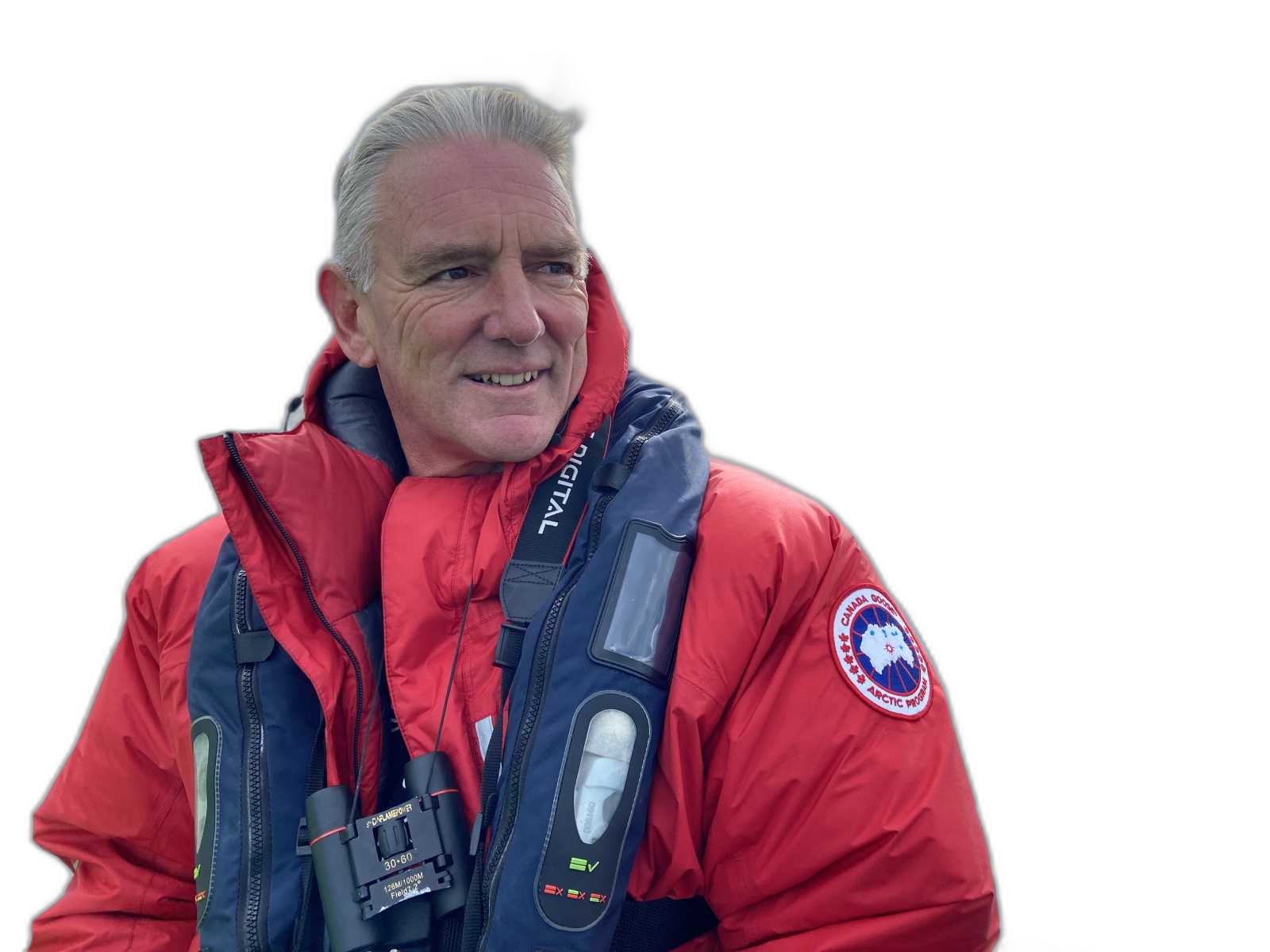
Nobody warns you about what comes next. The title, the board seat, the business — they do not just define what you do. They define who you are. When that changes, the real question begins. That is the work Alistair Wickens does.
A quiet, ten-minute reflective instrument. Your results arrive as a private report mapping where the weight is sitting right now.
Success has delivered you to a place you did not expect. This is not a crisis. It is a threshold.
The default answer is to do more of what worked before. The right question is entirely different.
The skills, the instincts, the hard-won experience — none of it disappears. But it was built for a different mountain. This one asks something more of you.
I spent three decades working alongside leaders at the top of their fields — not advising them through transition, but operating in the same rooms, at the same level, on the same problems. The question of what comes after arrived for me the same way it arrives for everyone. Without warning, and without a map.
I authored The View from the Wrong Mountain as an account of searching for that map. The Second Act Blueprint is what I built when I finally found it.
“Alistair cut straight through the noise with immediate clarity. He homed in on the core issue and gave me a direction that changed everything that followed.”
“Alistair understood the territory before I had finished describing it. That was the moment I knew this was different.”
“A rare quality of listening — and an even rarer quality of knowing what to do with what he hears.”
An Instrument for the Transition
The transition out of a first act is rarely linear. Because there is no standard corporate playbook for what follows the boardroom or the exit, the hardest part is often simply identifying where you are currently standing.
By looking past the presenting question to what is actually going on, The Signal maps where the weight is sitting right now. Upon completion, you will be sent a report written specifically for your current situation.
Ten minutes. Your results come with a report written for where you are.
Start hereThe View from the Wrong Mountain
Three passages. Written for people who have been there.
Somewhere around week twelve after my last exit, I realised my weekly trip to the supermarket had become the highlight of my week. I’m not being dramatic. It had. Tuesday morning: Waitrose. An entry in a diary. A reason to shower before noon. A small, structured moment in a suddenly unstructured life.
One afternoon my eldest granddaughter came home from school with news of sufficient importance to demand my full attention. A new teacher. Mrs Spencer. I heard the name, registered the details, said the right things — and filed it, apparently, in whatever part of the brain handles information it has no intention of retaining.
Ten minutes later I asked who the new teacher was.
She stopped. Rolled her eyes. Regarded me with the measured disappointment of someone who has learned, through bitter experience, that adults are unreliable.
“Papa. You never listen.”
She was seven. She wasn’t wrong.
One morning I found myself reorganising the spice cupboard with the intensity of someone preparing for a Michelin inspection. Halfway through alphabetising the paprika variants, I realised I wasn’t tidying — I was trying to recreate the feeling of being indispensable — and nothing says “identity crisis” quite like discovering you’ve become emotionally dependent on cumin.
The moment when success delivers you somewhere you did not expect to be — and what happens when you are finally honest about it.
Written for the people who performed fine for longer than was good for them. And who are beginning to wonder what comes next, and whether that question is allowed.
Not published yet — register your interest and we'll let you know when it lands.
On arriving at the place you spent years trying to reach — and finding that the feeling waiting for you there was not the one you had been promised.
On the interval that nobody prepares you for. The calendar clears. The phone goes quiet. The energy that built something significant has nowhere to go — and the things you reach for to fill that space turn out not to be what you needed.
On what it actually takes to build something that matters at this stage — not a replica of what came before, and not a retreat. Something that fits the person you have become rather than the one you were.
It is a reckoning with a question that very few people in your life will be able to help you answer — because most of them are still measuring success by the version of it you have just left behind.
The people who recognise themselves in it are those who woke up one morning and realised the diary was full and none of it felt like enough. Or those who left — by choice or otherwise — and found the silence that followed more disorienting than they had expected, and more honest than anything that came before it.
It does not tell you what to do next. It keeps you company while you work that out.
Not published yet — register your interest and we'll let you know when it lands.
“A rare piece of writing that names something I had felt for years but never had words for. I read it in one sitting.”
The Second Act Blueprint is the private, one-to-one work that follows from the territory the book opens.
The Blueprint is not a programme you move through in sequence. It is a set of territories — each one addressing something real about what this chapter asks of you. Where you enter depends on where you are. Where you go next depends on what surfaces when you get there.
There is no curriculum. No cohort. No predetermined sequence. Where you enter depends on where you are.
Take The SignalReclaiming yourself from the role that defined you.
The role hadn’t contained my identity. It had been doing my identity’s job for thirty years without ever being asked to. It took an empty diary and a blinking cursor to understand that.
Restoring what decades of overriding your own signals has depleted.
My nervous system developed a perverse loyalty to 3 a.m. No crisis. No deal unravelling. Just the existential variety of insomnia that doesn’t even have the decency to come with a problem attached. The engine was still running. It just had no brief. This territory gives it one.
Finding what actually matters, beneath the noise of what should matter.
There is a difference between work that fires you up and work that fulfils you. They feel identical from inside a full calendar. They do not feel identical at six months post-exit. This territory is where you find out which was which.
Rebuilding the systems that held you, now as choices instead of defaults.
The second act without structure is not freedom. It is a full diary that doesn’t point anywhere — activity that looks purposeful from the outside and feels increasingly hollow from the inside. I know, because I built exactly that for eight months, and called it a Second Act until my wife pointed out I’d rebuilt the thing I’d left with a better story.
Distinguishing between the work you want to do and the person you need to become.
James was on the train to London with a flask of coffee and thirty years of IT leadership, describing his Second Act as “supporting the next generation of entrepreneurs.” I asked which ones, specifically. He looked out of the window as though I’d asked something unreasonable. That pause is the gap this territory closes.
Understanding what’s actually holding you back, and what becomes possible when you don’t.
The car. The property. The investments. Each one a quiet answer to a question nobody admits they’re asking. This territory isn’t about diminishing what the first act built. It’s about understanding what it was actually for — and what, now that it’s there, it frees you to do.
Building work that outlasts your involvement with it.
I gave a stranger a coffee on a seafront bench. I walked away thinking nothing of it. What followed — the housing portfolio, the factory, The Copper Table, families with front doors — none of it was planned. The full chain is never visible. This territory is where you decide what kind of chain you want to set in motion.
Locating Your Entry Point
The seven territories of the Blueprint are entirely non-sequential. There is no rigid curriculum or fixed cohort to force yourself into; your true entry point must emerge naturally from where you stand right now.
To determine which territory requires your immediate attention — and which can safely wait — we use The Signal.
This is a clear-sighted account of where you actually are — and what the Second Act is likely to ask of you. Your responses will bring you directly to a detailed personal report on your readiness, where the real weight is sitting, and what tends to help at your current pace.
Whether you are preparing for an imminent exit, navigating the immediate silence of an empty diary, or mapping out a partner-led transition, look at the terrain clearly first.
The Signal locates your entry point.
Take The SignalThe energy doesn’t leave when you do. The structure does. This was written for the interval between those two — by someone who’s been there more than once and didn’t find it easy.
The book →
“Alistair understood the territory before I had finished describing it. That was the moment I knew this was different.”
“A rare quality of listening — and an even rarer quality of knowing what to do with what he hears.”
Ten minutes. Your results come with a report written for where you are.
Take The SignalThe foundation
My own professional life began at Moorfields Eye Hospital — working alongside clinical professionals and surgeons operating at the very limit of what medical science could do. From there, my clinical work developed around a specialist interest in the neurological development of eyesight in babies and young children. It was not the obvious beginning for someone who would spend the next three decades building businesses. But it gave me a way of seeing that I have carried into every room since.
The first act
The early years were spent working across the intersection of health data and human behaviour with some of the world’s leading financial institutions — work that led eventually to a leadership programme with one of the world’s preeminent insurance groups, reserved for those identified as future group CEOs. It was serious, demanding work, and it felt like the map for the decade ahead. Then September the eleventh happened. Within months, the map had been redrawn. I stepped into a health technology startup I would run as chief executive for the better part of fifteen years — and built it into something none of us had quite envisaged at the outset. Global partnerships. Real scale. A brand that carried genuine weight in its market. We sold the UK operations in 2018. By most measures, the first act had delivered. And then, for the first time in a very long time, I had to figure out what came next.
The second chapter
I didn’t stop. That’s worth saying. The second chapter wasn’t retirement — it was another build. A housing venture in my home town, founded on the conviction that business could house families who needed a front door and keep every pound circulating within the same local economy. To create the scale that vision required, we built a factory: purpose-built to produce affordable, precision-engineered homes. And to employ men the system had largely written off. Not as a social programme bolted on. As the business model itself. It didn’t survive. For reasons that were partly market, partly timing, and partly ours. I’ve thought carefully about all three.
The reckoning
The second exit brought something the first hadn’t. Not just the accumulated experience of two very different journeys — but a clarity about what mattered that simply wasn’t available in 2018. And then, almost immediately, a cancer diagnosis. Having navigated two exits and arrived at what should have been a moment of resolution, that was a cruel twist. But it had the effect such things always do: of concentrating the question considerably. The skills were still there. The appetite was still there. The credibility, the capital, the contacts — none of that disappears. What disappears is the structure that told you who you were. And the question of what to build in its place — something that actually matters, not just something that fills the gap — turned out to be a different problem from any I’d been trained to solve. I had to work it out. And I did. But it took longer than it needed to, and cost more than it should have.
What came next
That experience is what everything that follows is built on. The View from the Wrong Mountain is the book I wrote from inside it — the loss of identity, the false stories about what comes next, the slow work of building something real from what remained. I wrote it because I needed to read it and it didn’t exist. The Second Act Blueprint is what I built for the people who are ready to do the same. Not coaching. Not consulting. Peer-level work with leaders who’ve operated at a similar altitude, on the question that actually matters once the summit no longer does: what to build that means something — and how to move from clarity to momentum without wasting years finding out. I’ve been through this more than once. I’ve done the thinking. And if any part of this page has felt like recognition rather than biography, the right next step isn’t a conversation — it’s a question.
The best thinking happens in closed rooms. Alistair facilitates unvarnished, confidential dialogues in spaces where institutional and personal stakes collide—founder retreats, leadership councils, the moments where transition is live and the corporate script stops working. These are conversations shaped for the specific room, the specific question that needs addressing.
Alistair speaks on a single subject: the executive transition—that moment when high-achieving leaders reach the summit of their First Act and face the silence of what comes next. The raw psychology, identity shifts, structural architecture of that terrain.
Not rotating business presentations. One foundational address.
How he enters depends on the room. Exited founders and private wealth networks ask about legacy and redirecting entrepreneurial drive. Corporate boards ask about succession and the vacuum left by departing visionaries. Portfolio CEOs and their backers ask about the stamina required for long-term scale and eventual alignment at exit.
Same address. Different doors.
In-Person Keynotes & Retreats
High-impact, presence-driven sessions for your most critical environments. Alistair grounds your executive team, private founders, or board members with a sharp, anchoring perspective on leadership transitions.
EnquireStrategic Virtual Briefings
Direct senior-level insights delivered straight to your leadership council or boardroom. A concentrated live address built for senior schedules, with an unvarnished Q&A.
EnquireBespoke Digital Masterclasses
Scalable, high-production digital insights for your broader network. A bespoke, pre-recorded address designed to guide your community through the psychological realities of organisational change.
EnquireThe best speaking engagements begin with a specific conversation. To discuss a tailored address or series for your organisation, please provide the initial details below. Alistair reviews all peer invitations personally.
If the work feels relevant to your organisation, that is where to begin. Alistair reviews all invitations personally.
Place an EnquiryWriting, conversation, and coverage. Rooted in thirty years of navigating the climb, the summit, and the silence that follows—and in the questions leaders carry when the familiar script stops working.
Articles loading. Check back shortly.
Press coverage and speaking write-ups appear here as they are published.

Alistair Wickens · 2 minutes
A forty-five-minute conversation. No agenda except the right one. If the Second Act Blueprint is the right fit, we will both know by the end.
Book a First Conversation
This is the next step.
A forty-five-minute conversation. No agenda except the right one. If the Second Act Blueprint is the right fit, we will both know by the end.
Your report has been sent — check your inbox.
Book a First Conversation
You’re closer than most people get.
The Signal suggests the internal picture is clear. What’s around you hasn’t caught up yet. Your report sets out what that means and what’s worth attending to while it does.
Your report has been sent — check your inbox.
Return to Home
The timing is right, but something in your thinking needs to clarify first.
Your report sets out what the Signal found — and what’s worth attending to before you’re ready to act.
Your report has been sent — check your inbox.
Return to Home
Not every moment is the right moment.
Your report sets out where you are in the process of working out what’s next — and what tends to change with time. The door is open when the picture changes.
Your report has been sent — check your inbox.
Return to Home